SAP Analytics Cloud: Predictive Analysis via inbuilt Machine Learning
By Trijotech Team/ November 2022Brief Overview of SAP Analytics Cloud Predictive Analysis & Machine Learning
SAP Analytics Cloud Predictive Analysis with Machine Learning is a powerful suite of tools and capabilities within SAP Analytics Cloud that empowers organizations to harness the potential of data for advanced analytics and decision-making. It combines predictive modeling, machine learning algorithms, and augmented analysis features to unlock valuable insights from data. By leveraging these tools, users can make accurate predictions, identify patterns, and optimize business processes.

Importance of leveraging data for decision-making
In today’s data-driven world, organizations face an abundance of data that holds tremendous potential for informed decision-making. The ability to extract meaningful insights from data and transform them into actionable intelligence is crucial for staying competitive. SAP Predictive Analysis with Machine Learning enables businesses to tap into their data resources, analyze historical patterns, and make predictions about future outcomes. By leveraging data for decision-making, organizations can optimize processes, mitigate risks, identify opportunities, and ultimately achieve better business outcomes.
The rapid growth of data volume and complexity poses challenges in extracting actionable insights manually. SAP Predictive Analysis with Machine Learning addresses this challenge by providing automated and augmented analysis capabilities that streamline the process of data analysis and prediction. By leveraging the power of machine learning algorithms, organizations can uncover hidden patterns, generate accurate forecasts, and gain a deeper understanding of their data. This empowers decision-makers to make data-driven decisions based on reliable insights, improving the overall effectiveness and efficiency of their decision-making processes.
Understanding SAP Analytics Cloud Predictive Analysis & Machine Learning
1. Definition and key features:
SAP Analytics Cloud Predictive Analysis with
Machine Learning is a comprehensive set of tools and features that empower organizations to
leverage advanced analytics and machine learning capabilities within the Analytics Cloud
platform. With these tools, users can perform predictive analysis, build predictive models,
and derive valuable insights from their data. Key features include automated machine
learning, data wrangling, R integration, collaboration, storytelling, and augmented
analytics functionalities like Smart Discovery, Tables, and Time Series Charts. These
features provide users with the ability to explore data, create predictive models, and
visualize outcomes.
2. How it helps in predicting outcomes and trends:
SAP Predictive Analysis
with Machine Learning enables organizations to forecast future outcomes and identify trends
by leveraging historical data. With machine learning algorithms and predictive modeling
techniques, users can analyze patterns, correlations, and variables to make accurate
predictions. By uncovering insights and understanding relationships within the data,
organizations can anticipate customer behavior, market trends, and operational patterns.
These predictions aid in strategic decision-making, resource allocation, risk management,
and planning processes. By harnessing the power of predictive analysis, organizations can
gain a competitive edge by proactively addressing challenges and capitalizing on
opportunities.
3. Integration with existing SAP systems: SAP Analytics Cloud Predictive Analysis with Machine Learning seamlessly integrates with existing SAP systems, such as SAP S/4HANA and SAP Business Warehouse (BW). This integration allows organizations to leverage their data assets stored within these systems and perform predictive analysis directly within the Analytics Cloud environment. By connecting to these systems, users can access relevant data sources, combine data from multiple systems, and apply predictive models to gain deeper insights. This integration enhances the usability and efficiency of the predictive analysis capabilities by leveraging the existing data infrastructure and ensuring data consistency across the organization.
By utilizing the integration capabilities, organizations can tap into a wealth of data available in their SAP systems and leverage it for predictive analysis and machine learning purposes. This seamless integration streamlines the workflow and provides a holistic view of the data, enabling users to make data-driven decisions with greater accuracy and confidence.
Benefits of SAP Predictive Analysis & Machine Learning
1. Improved accuracy in forecasting and planning
One of
the key benefits of
SAP Predictive Analysis with Machine Learning in Analytics Cloud is the improved accuracy in
forecasting and planning. By leveraging historical data and applying advanced algorithms,
organizations can make more accurate predictions about future outcomes. This accuracy is
particularly valuable for demand forecasting, sales projections, and financial planning.
With reliable forecasts, businesses can optimize inventory levels, allocate resources
effectively, and make informed decisions to meet customer demands and maximize
profitability.
2. Enhanced decision-making capabilities
SAP Predictive
Analysis with
Machine Learning empowers organizations with enhanced decision-making capabilities. By
analyzing large volumes of data and extracting meaningful insights, decision-makers can make
informed and data-driven choices. Predictive models and machine learning algorithms provide
valuable insights into customer behavior, market trends, and potential risks. This enables
businesses to identify opportunities, mitigate risks, and develop strategies that align with
market dynamics and customer preferences. The result is more effective decision-making,
improved business outcomes, and a competitive edge in the market.
3. Optimization of business processes
Another significant benefit of SAP
Predictive Analysis with Machine Learning is the optimization of business processes. By
analyzing historical data, organizations can identify inefficiencies, bottlenecks, and areas
for improvement within their operations. Predictive analytics helps optimize supply chain
management, production planning, and resource allocation. By understanding demand patterns,
organizations can streamline inventory management, reduce stockouts, and optimize
procurement processes. Furthermore, predictive models can optimize maintenance schedules,
minimizing downtime and maximizing equipment utilization. Overall, this optimization of
business processes leads to cost savings, improved efficiency, and increased customer
satisfaction.
4. Identification of patterns and anomalies
SAP Predictive Analysis with
Machine Learning enables organizations to uncover valuable patterns and anomalies hidden
within their data. By analyzing historical and real-time data, businesses can identify
trends, correlations, and outliers that may go unnoticed through traditional analysis
methods. This identification of patterns and anomalies has several benefits.
It helps detect fraudulent activities, such as financial fraud or security breaches, allowing organizations to take timely action. Moreover, it enables businesses to understand customer behavior, preferences, and segmentation more accurately, leading to targeted marketing campaigns and personalized customer experiences. By uncovering hidden insights, organizations can gain a competitive advantage, make proactive decisions, and mitigate risks effectively.
Use of Augmented Analytics in Analytics Cloud:
1. Smart Discovery: Smart Discovery is a powerful augmented analytics feature in SAP Analytics Cloud that leverages machine learning algorithms to automatically analyze data and discover insights. It enables business users, without extensive data science knowledge, to explore data and gain valuable insights quickly and easily.
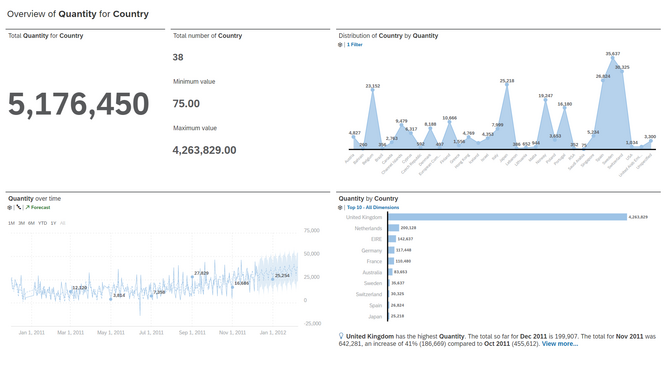
Smart Discovery uses automated pattern detection to identify relationships, correlations, and outliers within the data. It automatically suggests relevant dimensions, measures, and visualizations based on the selected dataset. This helps users understand the significant factors influencing their data and uncover hidden patterns that might not be apparent at first glance.
A. The key steps involved in Smart Discovery are as follows:
i. Data Selection: Users can choose the dataset they want to analyze from various data sources available in SAP Analytics Cloud, including spreadsheets, databases, or SAP systems.
ii. Insights and Recommendations: Smart Discovery performs automated analysis on the selected dataset and generates insights and recommendations. These insights can include the most influential variables, the strength of relationships between variables, and potential outliers.
iii. Visualizations: Smart Discovery automatically creates interactive visualizations, such as scatter plots, histograms, or heat maps, to represent the discovered insights visually. These visualizations help users gain a deeper understanding of the data and its underlying patterns.
iv. Story Creation: Users can integrate the insights and visualizations generated by Smart Discovery into interactive stories or dashboards. This enables effective communication of the findings and supports collaborative decision-making.
Smart Discovery not only simplifies the data exploration process but also saves time by automating the identification of relevant insights. It enables business users to make data-driven decisions based on meaningful and actionable information.
2. Smart Predict: Smart Predict is another vital component of augmented analytics in SAP Analytics Cloud. It is a user-friendly predictive modeling tool that allows business users to create predictive models without extensive data science expertise.
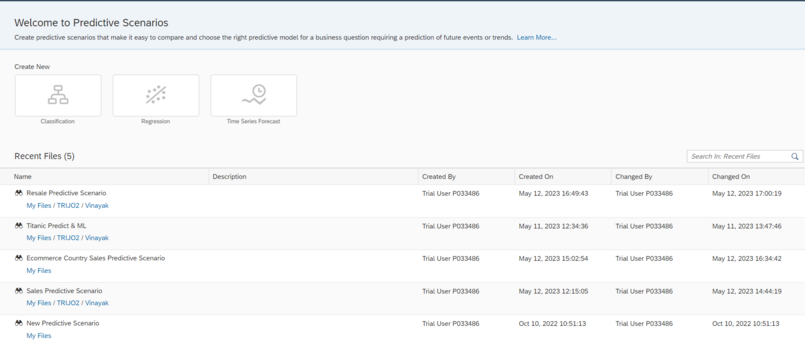
Smart Predict offers an intuitive interface that guides users through the process of building predictive models step by step. It automates many of the complex tasks involved in predictive modeling, such as data preparation, feature engineering, model selection, and evaluation.
B. The key features and functionalities of Smart Predict include:
1. Automated Machine Learning:
Smart Predict automates the
process of building predictive
models by applying various machine learning algorithms. It automatically selects the best
algorithm and model configuration based on the dataset and the prediction goal. It supports
three types of machine learning: classification, regression, and time series analysis.
Classification models are used to predict categorical outcomes or assign data into different
classes. Regression models are employed to predict continuous numerical values. Time series
analysis focuses on forecasting future values based on historical patterns and trends.
2. Model Evaluation:
Smart Predict provides evaluation
metrics to assess the performance of
predictive models. It calculates metrics such as accuracy, precision, recall, or root mean
square error (RMSE) to determine the model’s effectiveness. These metrics help users
understand how well the model is performing and make informed decisions about its
suitability for deployment.
3. Model Deployment:
Once a predictive model is built and
validated, Smart Predict allows
users to deploy the model for real-time predictions. The model can be integrated into
dashboards or applications, enabling users to make predictions on new data and gain insights
in real-time. This facilitates the utilization of predictive models in various business
scenarios, such as demand forecasting, customer segmentation, or fraud detection.
4. What-If Analysis:
Smart Predict supports what-if
analysis, allowing users to simulate
scenarios and understand the impact of changing variables on predictions. This capability
helps in sensitivity analysis and enables better decision-making by exploring different
possibilities. Users can adjust input variables and observe how it affects the predicted
outcomes, allowing them to evaluate different strategies and make informed choices.
By leveraging the power of Smart Predict in SAP Analytics Cloud, business users can harness the benefits of machine learning and predictive modeling without relying solely on data scientists. It empowers organizations to unlock valuable insights, make accurate predictions, and drive data-driven decision-making across various business domains.
C. Tables:
Tables feature in SAP Analytics Cloud is a powerful tool that enables users to perform calculations, create key figures, and apply advanced analytics functions on datasets. It provides a structured and organized view of data, allowing users to explore, manipulate, and analyze data in a tabular format. When it comes to predictive analysis and machine learning, tables play a crucial role in data preparation and integrating predictive analysis results within the analytical workflow.
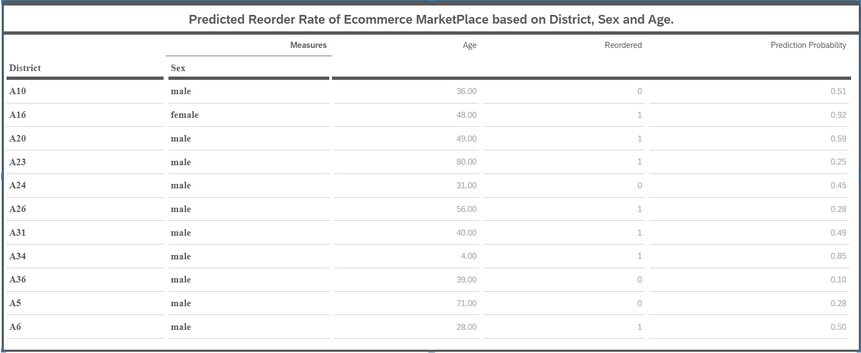
1. Data Preparation: Tables in SAP Analytics Cloud allow users to perform data wrangling tasks such as data cleansing, transformation, and aggregation. Users can apply various data preparation techniques to ensure data quality and consistency, which is essential for accurate predictive modeling. With the ability to handle large datasets, tables simplify the process of preparing data for predictive analysis.
2. Feature Engineering: Feature engineering involves creating new features or transforming existing features to improve the predictive performance of models. Tables in SAP Analytics Cloud provide a platform for creating calculated columns, derived measures, and aggregations that can be used as input variables for predictive models. Users can define complex calculations and apply mathematical operations directly within the tables.
3. Integration with Predictive Models: Tables seamlessly integrate with the predictive modeling capabilities of SAP Analytics Cloud. Users can incorporate predictive analysis results, such as model predictions or scores, directly into the table view. This integration allows for the easy comparison and evaluation of predicted outcomes against actual data, providing valuable insights for decision-making.
4. Advanced Analytics Functions: Tables offer a wide range of advanced analytics functions that can be applied to the data. These functions include statistical calculations, clustering analysis, outlier detection, and more. Users can leverage these functions within tables to gain deeper insights into the data and uncover patterns or anomalies that might be relevant for predictive analysis.
D. Time Series Charts:
Time Series Charts in SAP Analytics Cloud enable users to visualize and analyze data over time. They are particularly valuable for predicting future trends, identifying seasonality, and understanding the behavior of data patterns. Time Series Charts play a critical role in time series forecasting, which is essential for predictive analysis and machine learning.
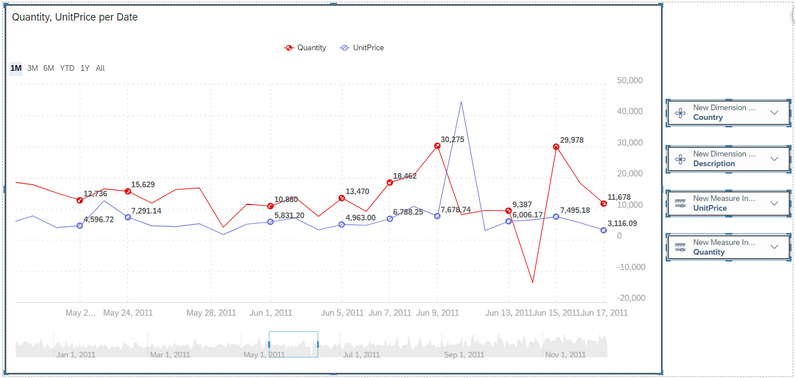
1. Trend Analysis:
Time Series Charts provide a clear
visualization of how data evolves over
time, making it easier to identify trends and patterns. Users can observe upward or downward
trends, cyclic patterns, and irregular fluctuations in the data. This understanding of
trends helps in predicting future outcomes and making informed decisions based on historical
patterns.
2. Seasonality Detection:
Many datasets exhibit
seasonality, where patterns repeat over
specific time intervals. Time Series Charts help identify these seasonal patterns, such as
daily, weekly, monthly, or yearly variations. By detecting and understanding seasonality,
predictive models can account for these patterns and improve forecasting accuracy.
3. Forecasting:
Time Series Charts facilitate forecasting
by providing a visual
representation of historical data and predicted values. Users can overlay the predicted
values on the chart to compare them with actual data points. This visual feedback helps in
evaluating the accuracy of predictive models and adjusting them if necessary.
4. Interactive Exploration:
Time Series Charts in SAP
Analytics Cloud offer interactive
features that allow users to zoom in, pan, and navigate through the data. Users can focus on
specific time intervals, examine data at different granularities, and explore details within
the chart. This interactivity enhances the understanding of time series data and supports
more in-depth analysis.
5. Anomaly Detection:
Time Series Charts help in detecting
anomalies or outliers in the data.
Unusual spikes, sudden drops, or unexpected patterns can be easily identified on the chart,
indicating potential anomalies that require further investigation. Anomaly detection is
crucial for quality control, fraud detection, and risk management in various industries.
Conclusion
SAP Predictive Analysis & Machine Learning, powered by augmented analysis in SAP Analytics Cloud, offers a wide range of benefits and applications for organizations.
Smart Predict, an integral part of SAP Analytics Cloud, enables users to build predictive models without requiring extensive data science expertise. It automates the model selection process, feature engineering, and evaluation, making it accessible to business users. With Smart Predict, organizations can accurately forecast outcomes, identify trends, and gain insights into various aspects of their business operations.
Smart Discovery, another component of augmented analysis, leverages machine learning algorithms to automatically analyze data and uncover hidden patterns, correlations, and insights. It simplifies data exploration and provides valuable insights that drive informed decision-making. Organizations can uncover new opportunities, understand customer behavior, and optimize processes by harnessing the power of Smart Discovery.
The insights derived from SAP Predictive Analysis with Machine Learning contribute to improved decision-making across various functions. By leveraging predictive analytics, organizations can enhance demand forecasting, optimize inventory management, streamline supply chain operations, and improve resource planning. It empowers business leaders to make data-driven decisions and align their strategies with accurate predictions.
Future potential and growth of predictive analytics in businesses:
The future potential and growth of predictive analytics in businesses are immense. As organizations continue to accumulate vast amounts of data, the need for advanced analytics tools, such as SAP Predictive Analysis & Machine Learning, will only intensify.
Predictive analytics has the potential to revolutionize industries by driving innovation, optimizing processes, and improving customer experiences. With advancements in machine learning algorithms, integration with emerging technologies like AI and IoT, and access to real-time data, predictive analytics will become even more powerful in uncovering valuable insights and driving business success.
Furthermore, as businesses increasingly recognize the importance of data-driven decision-making, the demand for skilled professionals in predictive analytics will rise. Organizations will invest in building data science capabilities, fostering a culture of analytics, and integrating predictive analytics into their core operations.
In conclusion, SAP Predictive Analysis & Machine Learning, via augmented analysis in SAP Analytics Cloud, offers a wide range of benefits and applications. It empowers organizations to predict outcomes, gain valuable insights, and make informed decisions. The future of predictive analytics is promising, with continuous advancements and increasing adoption by businesses. By embracing predictive analytics, organizations can stay ahead of the competition, optimize their processes, and drive sustainable growth.
To read more of our blogs you can surely click here.
Check out other video blogs.
Disclaimer: All the opinions are solely for information purposes, and the author doesn’t recommend or reject any tools. It should be done after your own due diligence.